
One security fabric for the whole AI factory
An AI factory is more than a model. It is the models you bring, the data you feed them, the prompts and APIs that call them and the agents that act for them. Kronos Lab puts one fabric across all of it.
The full fabric
Models, data, prompts and agents come in through four bands, into one policy plane and one audit trail. The same gates apply whichever platform you serve on, and every control writes back to the same telemetry stream.
- Policy and governance
- Identity and access
- Audit and compliance
- Encryption and signing
- Integrated workflows
Four intake bands
Each band guards one way into a running AI system, with its own gates, in order, and the same record at the end.
Model supply chain
Nothing serves that was not scanned, described and signed. A model arrives from Hugging Face, NGC, an open-source repo, your own team or an air-gapped mirror, and it has to earn its way to an endpoint.
Data ingestion and encrypted retrieval
Retrieval is an attack surface, and an embedding is not anonymous: source content can be rebuilt from it. Only clean, de-identified, signed content reaches the store, and it arrives already encrypted under keys you hold.
Prompts, APIs and agents
Every prompt is a policy decision before it is a model call, and every agent action is checked against what that agent is allowed to do. User input, API traffic and autonomous actions pass the same checks, and the answer can be no.
Observability and audit
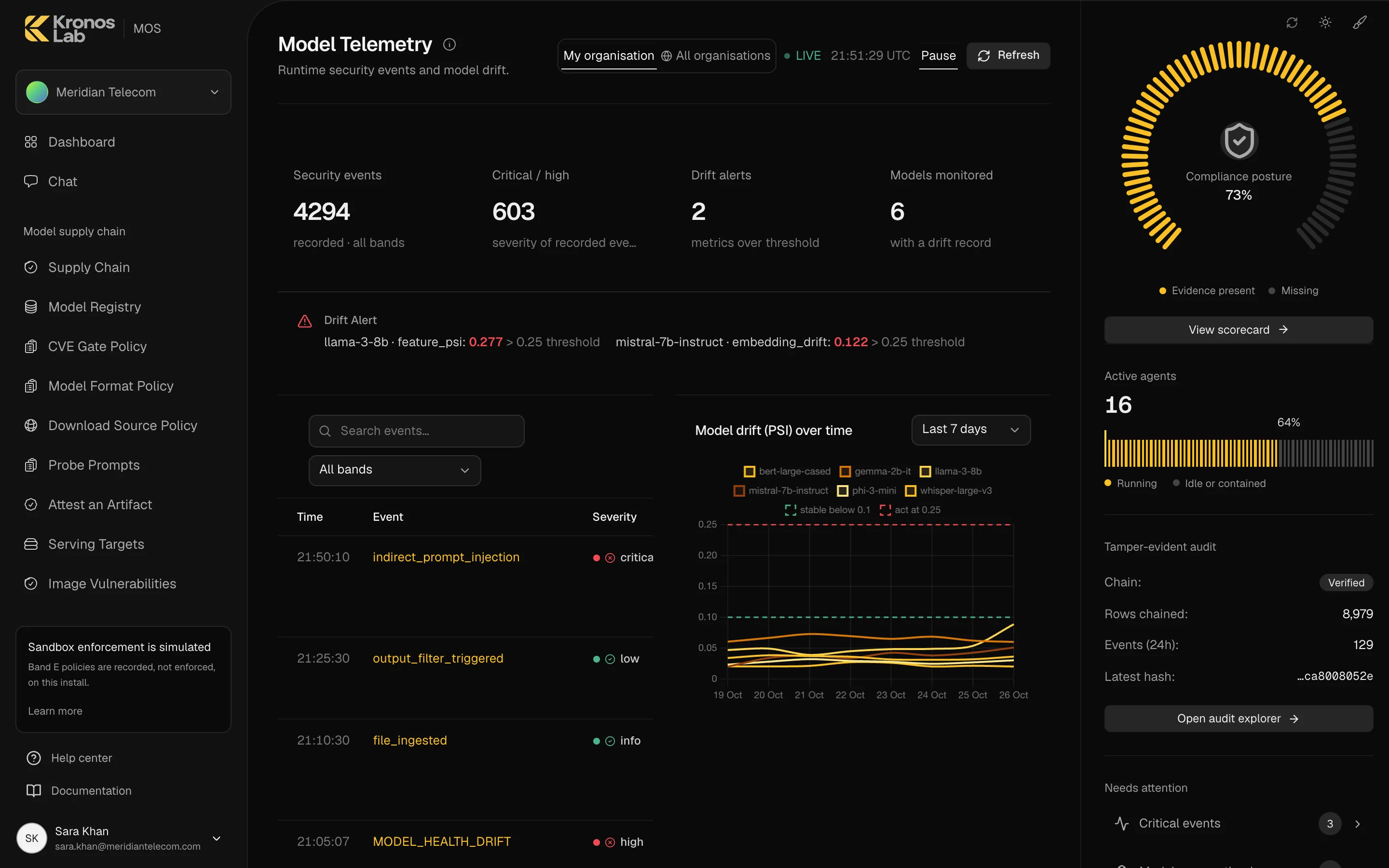
Every gate in the other three bands writes here. One normalized stream, one immutable audit record and one set of cases in your SOC, so a control you claim is a control you can show.
A fifth band for agents and MCP gateways is in development; agent controls run in the prompts, APIs and agents band today.
One policy plane
The bands don't each bring their own rules. They share five services, so one decision means the same thing everywhere.
Policy and governance
Every gate in every band is an Open Policy Agent decision. Policy lives as code, versioned and reviewed like any other change, and one rule can apply across all four bands.
Identity and access
Users, tenants, services and agents each carry an identity. Agents get SPIFFE workload identities, so a running workload is verified, not assumed.
Audit and compliance
Every decision lands in one append-only record, mapped to the frameworks you answer to and forwarded to your SIEM.
Encryption and signing
Models and datasets are signed with Sigstore. Content is encrypted under keys you hold, with post-quantum algorithms alongside the classical ones.
Integrated workflows
Findings open tickets, incidents land in your SOC queue and remediation runs through your ITSM. The platform hands work to the tools your teams already use.
Every workload inherits the controls
Whatever you deploy to, it is gated the same way and writes back to the same telemetry stream.
Model serving
Endpoints come up with their runtime guardrails attached, on KServe, NVIDIA NIM or Triton.
Applications
Chat, search and copilots built on your models inherit the same prompt and output checks.
APIs and services
Service-to-service calls pass the same authorization, rate limits and filters as people do.
Agentic systems
Agents run with an identity, a sandbox and a policy on every tool, model and data source they touch.
Edge and on-prem
The same gates run on your own hardware, in your jurisdiction, including air-gapped sites.
Where it runs
On the infrastructure you already run, under keys you already hold.
Any Kubernetes platform
SUSE Rancher, Red Hat OpenShift, Rafay or NVIDIA's AI platforms. The fabric sits above the platform, so you can change it without changing your controls.
Your hardware and keys
GPU node pools, in-jurisdiction KMS or HSM, and isolated landing, quarantine and clean storage tiers for what comes in.
Sovereign by default
Nothing leaves your environment for a vendor cloud. The platform holds no key material, so a breach of the platform is not a breach of your content.