
Audit
Observability and audit
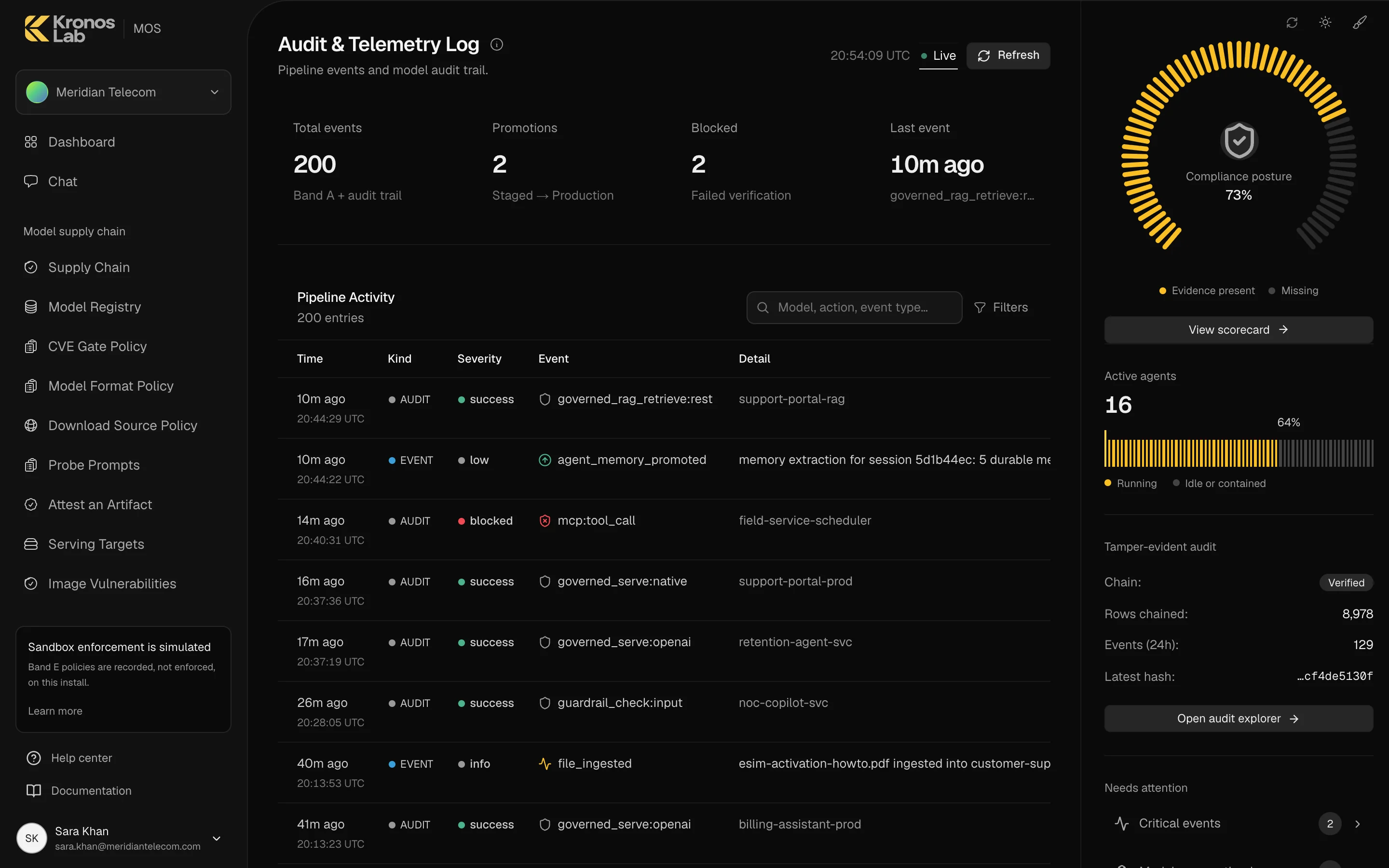
Every gate in the other three bands writes here. One normalized stream, one immutable audit record and one set of cases in your SOC, so a control you claim is a control you can show.
- Collect
Pipeline, runtime, registry and guardrail events
Model inventory, prompt and response violations, tool-call traces, lineage and scan results, gathered from every band into one schema.
Collectcollect.ingest sources=pipeline,runtime,registry,guardrail events=1.8M/24h
- Detect
Drift, violations and performance
Evidently tracks model drift against a reference window. Policy violations and latency budgets are evaluated on the same stream, so quality and security share one signal.
Detectdetect.drift psi=0.21 (warn) policy_violations=37 p95=812ms
- Audit record
Immutable, retained, verifiable
Decisions are written append-only, hash-chained and kept under a retention policy. This is what you hand a regulator when they ask what the model did in March.
Audit recordaudit.write repo=kronos-audit immutable=true retention=365d chain=verified
- SIEM forward
Splunk, Sentinel, QRadar or ELK
Events are normalized to CEF and OCSF and forwarded to the SIEM you already run. AI events arrive as security events, correlated with the rest of your estate.
SIEM forwardsiem.forward target=splunk format=cef+ocsf lag=4s
- SOC response
Investigate, respond, remediate
Analysts work AI incidents in their existing queue, with a playbook per class of event. Remediation is raised in your ITSM, so the loop closes outside the platform on purpose.
SOC responsesoc.respond case=INC-4412 sev=medium playbook=model-abuse itsm=SR-90311